


International Whistleblower Day: Institutions continue to persecute whistleblowers more than corruption
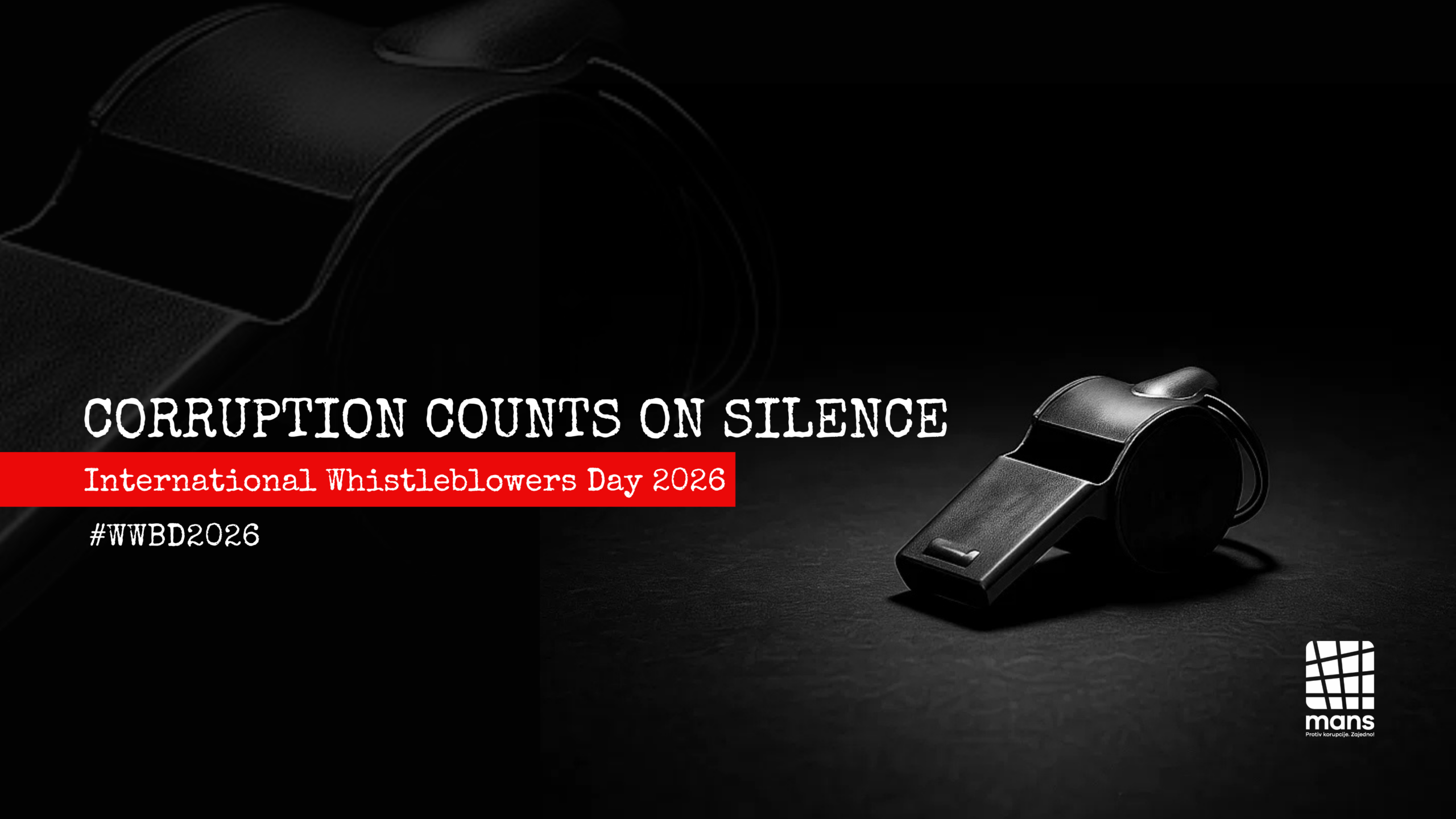
MANS warns that Montenegro still does not have a special law on whistleblower protection, while the practice of state institutions continues to show that the focus is often on detecting those who report illegalities, instead of sanctioning the abuses themselves.
On the occasion of the International Whistleblower Protection Day, which is celebrated on June 23, MANS warns that Montenegro is once again celebrating this date without a special law that would comprehensively regulate the protection of persons who report corruption and other illegalities.
However, the problem is not only that the new law has not yet been adopted. The latest cases show that patterns of behavior are still recurring, in which institutions often find it more important to find out who raised the issue than to determine whether the issue actually exists. Such practices send a strong discouraging message to potential whistleblowers and further undermine trust in the protection system. Therefore, the existing legal framework today does not provide an incentive for reporting corruption and other illegalities, but rather creates a justified fear among many citizens and officials that those who report the issue could bear the greatest consequences.
Although the draft of the new Whistleblower Protection Law was prepared and presented to the public last year, its adoption is still pending. The proposed text contains numerous quality solutions and largely follows European standards in this area, which is why its adoption represents an important step forward. However, Montenegro’s experience shows that the quality of the legal text in itself is not enough if there is no institutional readiness to implement its solutions consistently and efficiently.
The practice of whistleblower protection to date shows that this is where the biggest problems lie. The number of cases in which persons who have reported corruption or other illegalities have received effective protection has remained very limited, while the consequences for those who decide to report irregularities are often serious and long-lasting.
Following the political changes of 2020, it was reasonable to expect that there would be an increase in the number of reports of corruption and other illegalities from citizens and officials who had witnessed various abuses for years. Such a development would be a natural consequence of strengthening trust in institutions and the belief that reporting irregularities would finally lead to concrete results.
Unfortunately, practice shows a different picture. Even today, Montenegro has not managed to build an environment that encourages reporting of corruption and provides sufficient trust to those who are considering speaking out about illegalities. Therefore, citizens, but also numerous civil servants, still submit information about possible abuses much more often to the media and civil society organizations than to the competent institutions or through formal mechanisms provided for by the Law on the Prevention of Corruption. This shows that even after political changes, not enough has been done to restore trust in institutions that are supposed to protect the public interest and those who decide to report corruption.
Of particular concern is the fact that the Agency for the Prevention of Corruption (APC), as the institution that currently plays a central role in the whistleblower protection system, has faced serious staffing and professional limitations for years. Without significant capacity building of APC, as well as other institutions involved in whistleblower protection, there is a serious risk that the new law will remain just another high-quality regulation with limited scope in practice.
An additional problem is the attitude of the state apparatus towards the institution of whistleblowers. Instead of focusing on allegations of corruption, abuses and other illegalities that whistleblowers reveal, numerous examples show that institutions often deal much more energetically with the question of who provided the information to the public and who helped the whistleblower in doing so.
Recent cases, including those involving the National Security Agency, demonstrate a worrying pattern of behavior that prioritizes identifying sources of information and sanctioning those who have made possible public knowledge of possible illegalities, while downplaying allegations of abuse and violations of the law. Such an approach sends the message that uncovering suspected illegalities is a bigger problem for the state than the illegalities themselves.
Such attitude of institutions towards whistleblowers shows that a significant part of the state apparatus has still not accepted the simple fact – whistleblowers are not the problem, but part of the solution. They often represent the last line of defense of the public interest in situations when internal controls fail and institutions are not prepared to detect or prosecute illegalities themselves.
Of particular concern is the fact that six years after the political changes of 2020, patterns of behavior that have discouraged reporting of corruption and abuses for years are still being repeated. This shows that the change of government in itself was not enough to change the institutional culture and attitude towards those who point out illegalities. On the contrary, in some cases, the impression is that the system’s willingness to protect whistleblowers is still weaker than its willingness to find and sanction those who made it possible for information to reach the public.
As long as the state apparatus is more concerned with discovering who provided the information than what that information reveals, Montenegro will not have an effective system for fighting corruption, no matter how many laws it adopts. That is why we welcome the International Whistleblower Protection Day with the message that Montenegro needs not only a new law, but also a fundamental change in the attitude of institutions towards those who protect the public interest.
Whistleblowers are not a threat to the state, but one of society’s most important allies in the fight against corruption and abuse of power. As long as institutions show more determination to find and punish those who speak out about problems than those who create them, whistleblowers will have no real protection, and the fight against corruption will remain seriously limited.
MANS

Phones
+382 20 266 326
+382 20 266 327
+382 69 446 094
Fax
+382 20 266 328
Copyright © 2025 MANS. All rights reserved.