

Dubai trip was a gift after all – prosecutors must investigate why
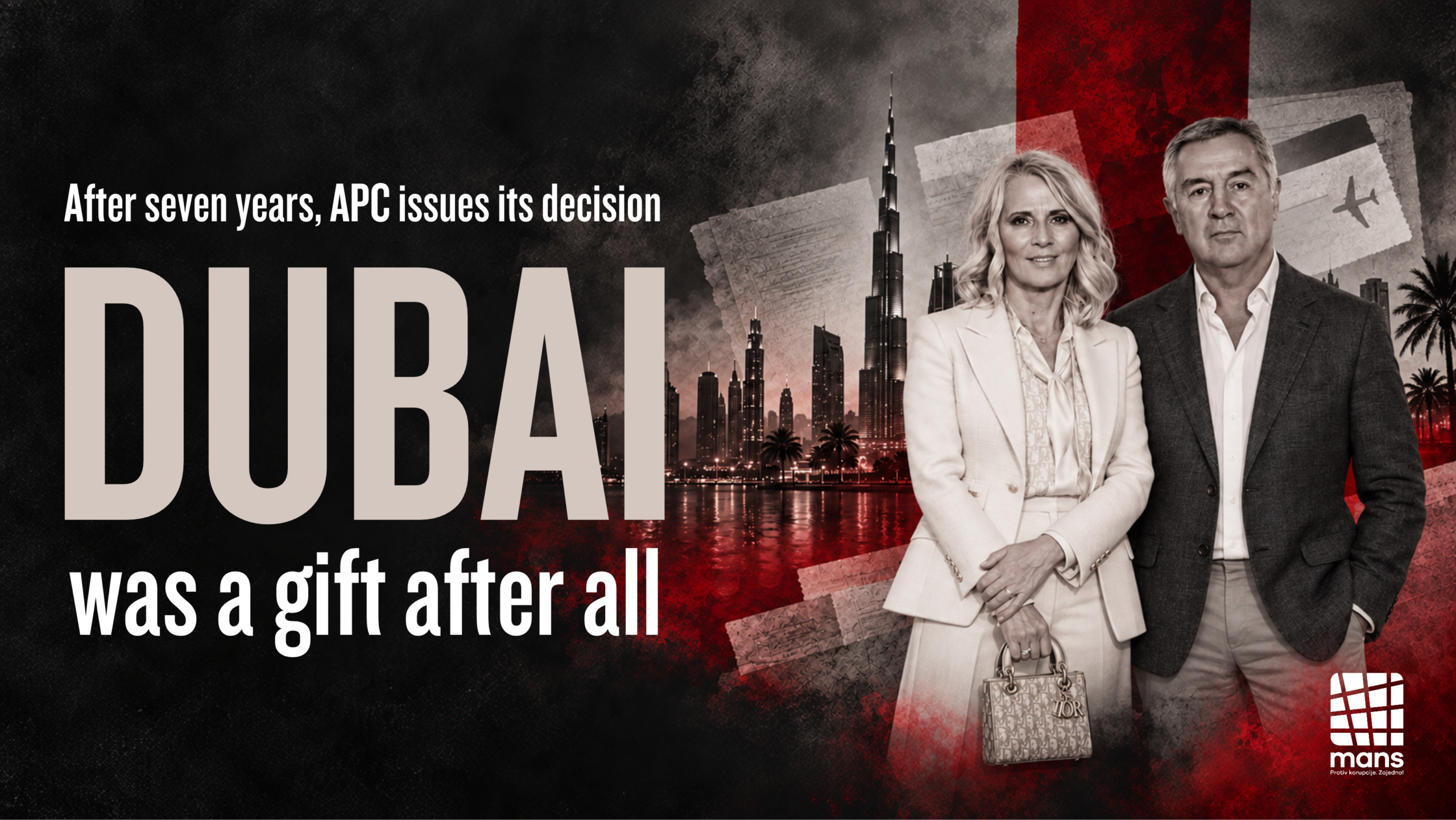
The decision of the Agency for the Prevention of Corruption (ASK), which found that Milo Đukanović violated the law by accepting paid travel and hotel accommodation in Dubai for himself and his wife, must prompt further investigation into this case. MANS calls on the competent prosecutor’s office to establish whether Duško Knežević secured any benefit for himself or his companies by financing the trip, and whether the gift was linked to decisions, influence or actions of the then Prime Minister. At the same time, MANS calls for an examination of the accountability of ASK’s former leadership for its handling of the case, which resulted in the violation being established only more than seven years after the complaint was filed and following two Administrative Court judgments overturning the Agency’s previous decisions.
Anti-corruption authorities must not focus primarily on the value of a gift, whether it consists of money, travel or another service. The fundamental question is what may have been “bought” through such a gift: access to a decision-maker, preferential treatment, a specific decision benefiting the gift-giver or protection of their business interests. This aspect of the relationship between Đukanović and Knežević must be examined by the competent prosecutor’s office.
ASK established that Đukanović, while serving as Prime Minister, accepted hotel accommodation and airline tickets for himself and his wife Lidija for a stay in Dubai from 25 to 30 March 2010, paid for by Knežević on behalf of the Atlas Group. The Agency concluded that Đukanović should have refused the gift and submitted a written report about it to the institution in which he held office.
It is particularly significant that ASK rejected Đukanović’s explanation that the trip was private and unrelated to his public office. A public official does not cease to be a public official when going on holiday, nor do paid airline tickets and hotel accommodation cease to constitute a gift because they were used during a private social visit. This position must become the Agency’s consistent practice towards all public officials, regardless of their political affiliation.
The explanation that this was a private social visit is further called into question by Đukanović’s own earlier statements. In January 2019, he publicly denied that Knežević was his friend, emphasising that he was highly selective about his friendships. If, according to the recipient himself, the gift-giver is not his friend, financing the trip cannot credibly be explained as an ordinary gift between friends. The private nature of the trip does not explain why the owner of a business group covered the expenses of the then Prime Minister and his wife.
The prosecutor’s office should therefore establish the circumstances in which the trip was arranged and paid for, the source and flow of the funds, and the business interests that Knežević and his companies were pursuing before state institutions during the relevant period. It is necessary to examine whether those interests were linked to Đukanović’s decisions or actions, including any influence on other state bodies, and whether payment for the trip was connected to an expected or actual favour in return.
ASK’s decision does not, in itself, prove that such a favour existed. However, the established acceptance of a prohibited gift from a businessman raises the question of a possible connection between a public official’s private benefit and the exercise of his public powers. That question must not remain unanswered.
It took more than seven years from MANS’s complaint and two Administrative Court judgments for the Agency to establish a violation of the law in this case. Such handling of the case represents a serious failure of a system that should promptly identify and prevent improper relationships between public officials and private interests. The accountability of the Agency’s former leadership, whose decisions in this case were challenged twice before the Administrative Court, must also be examined.
Citizens have the right to know who financed the private expenses of the highest-ranking state officials and whether those gifts were linked to decisions made to the detriment of the public interest. Now that ASK has established a violation of the law concerning the acceptance of the gift, it is for the competent prosecutor’s office to act. This case must not be closed without examining why Knežević paid for the trip and determining whether he expected or received a benefit from the then Prime Minister in return.
MANS

Phones
+382 20 266 326
+382 20 266 327
+382 69 446 094
Fax
+382 20 266 328
Copyright © 2025 MANS. All rights reserved.