

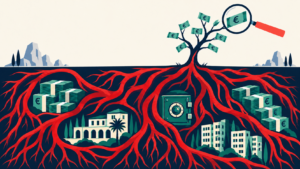
MONITOR Interview: THE HARDEST PART OF THE JOB IS YET TO COME
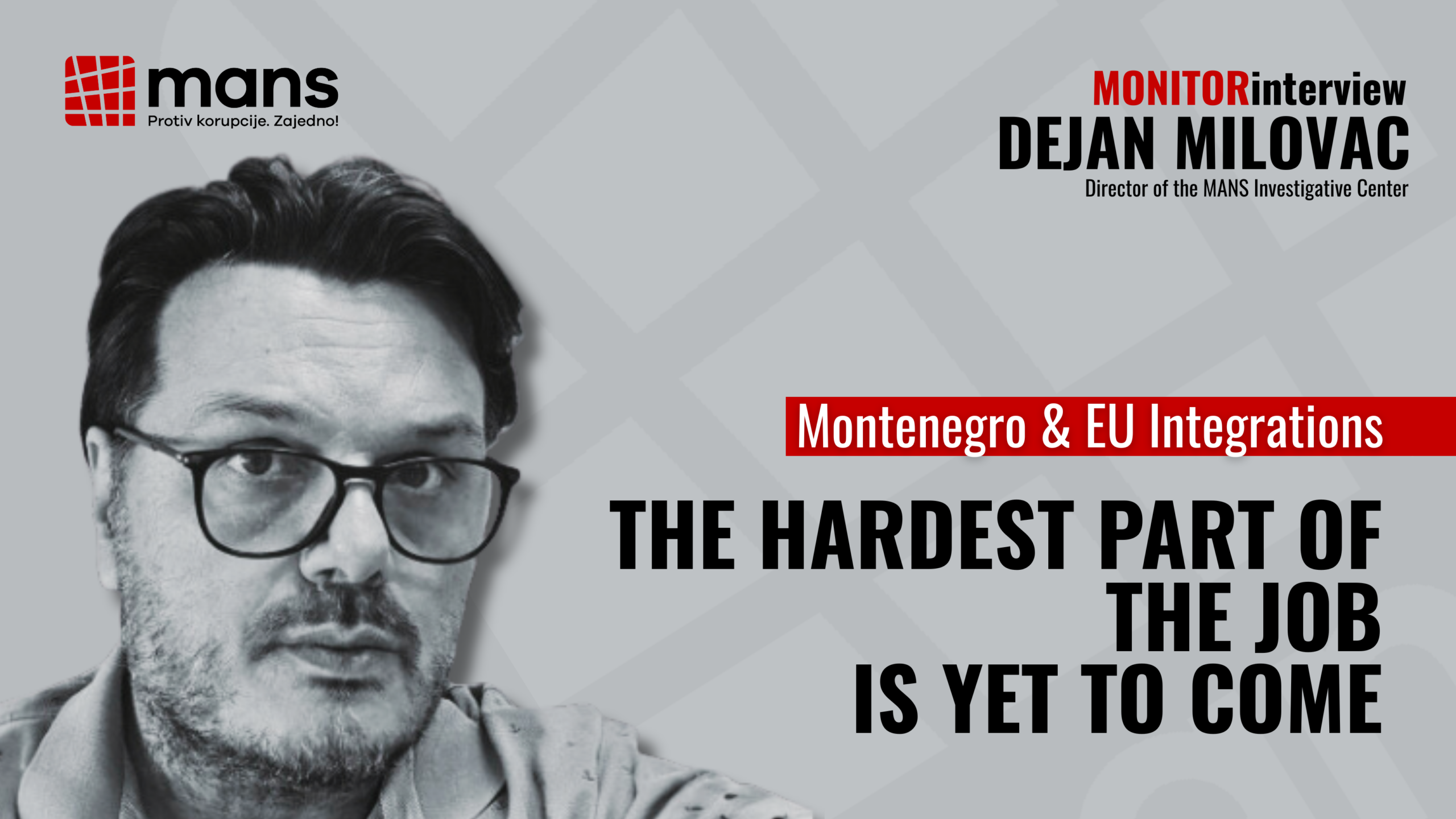
I would like young people to see the award that Vanja received as a message to not give up on their beliefs even when things seem difficult and almost impossible. Societies do not change overnight, nor do they change on their own. They are changed by people who are willing to persevere, work professionally, and do not compromise when it comes to basic values such as honesty, responsibility, and public interest.
Author: Milena Perović (Monitor)
MONITOR: MANS Executive Director Vanja Ćalović was presented with the “Giorgio Ambrosoli” award in Milan this week, an award given under the patronage of the President of the Republic of Italy for integrity, responsibility and professionalism in protecting the rule of law. She said that she does not see the award only as a personal recognition, but as recognition of the work of MANS. How do you perceive it?
MILOVAC: Vanja is absolutely right when she says that this award cannot be seen only as a personal recognition. The award bears the name of a man who has become a symbol of professional integrity and courage in opposing organized crime and corruption. That is why its value goes beyond the individual and becomes a recognition of the values he represents.
For me, this award also has a special meaning. It is a great privilege to have spent the majority of my professional career at MANS, an organization that has shown that even in a small country with limited resources, a consistent fight against corruption can be waged. I have had the opportunity to work with people who have been willing to stand up to abuses of power for years, often at significant professional and personal risk. Few people have the opportunity to do work that they sincerely believe has social significance and to see concrete results from their work.
That is why I see this award primarily as a recognition of the work of MANS and all the people who have been part of our struggle for more transparent institutions, more accountable government and the rule of law over the past decades. Many of them have never been in the spotlight, but their work has contributed to the discovery, documentation and presentation of numerous cases of corruption, misuse of public resources and organized crime to the public despite numerous obstacles.
This recognition is given special weight by the fact that it comes at a time when Montenegro is facing perhaps the most important phase of its European journey. It is a confirmation that consistency, professionalism and defense of the public interest are recognized beyond the borders of our country.
It is very important that this award sends a broader message, especially to young people. Many grow up with the feeling that institutions are too slow, that change comes hard, and that an individual cannot significantly influence the society around them. In such an environment, it is easy to become indifferent or conclude that nothing can change.
The example of Giorgio Ambrosoli, as well as the people who are receiving the award that bears his name today, shows that integrity, professionalism and perseverance have value even when the results are not immediately visible. The most important changes almost never come quickly and are rarely the result of the work of one person or one generation.
I would like young people to see this award as a message to not give up on their beliefs even when things seem difficult or almost impossible. Societies do not change overnight, nor do they change on their own. They are changed by people who are willing to persevere, work professionally, and not compromise on basic values such as honesty, responsibility, and the public interest.
MONITOR: The image of Montenegro would definitely be different if it weren’t for your organization’s long-term dedicated work in exposing numerous abuses of power, corruption and organized crime. But how satisfied are you with the image of Montenegro today?
MILOVAC: I cannot say that I am satisfied, although there are certain reasons for optimism. However, when it comes to substantive changes, progress is slower than it should be. The key problem remains the fact that political corruption in Montenegro is not a set of individual incidents, but a systemic problem that has been built into the way the state functions for decades. Such a system did not emerge overnight, and therefore could not be changed simply by a change of government.
We did not use the time after 2020 as we could and should have. There was a unique opportunity then to offer a systemic response to the problem of systemic corruption, to reform institutions that were captured by political influence, to establish stronger mechanisms of government control, and to create conditions for true accountability of public office holders.
Instead, most of the political energy was spent on fulfilling narrow party interests, redistributing political power, and securing the best possible starting position for the next election cycles. Instead of deep reforms, we often witnessed the replacement of one party interest with another, while key problems remained unresolved.
This is particularly evident in areas that are crucial to the fight against corruption. We have not obtained sufficiently strong mechanisms to control political corruption, we have not solved the problem of party influence on employment and management of state resources, and the results in the area of financial investigations and confiscation of illegally acquired assets remain limited.
Of particular concern is the fact that employment in state-owned companies remains virtually beyond the reach of serious control. This segment represents one of the most important mechanisms of political influence on voters and one of the key reasons why the problem of misuse of public resources has not been fundamentally resolved.
The hardest part of the job is yet to come.
MONITOR : How do you see the findings of the recently published Non paper?
MILOVAC: The findings show that there is still a significant gap between the political optimism that accompanies European integration and the actual situation in the area of the rule of law.
This does not mean that there is no progress. The EC recognizes certain positive developments and the fact that Montenegro has made progress in the negotiation process. However, it is equally clear that key problems have not yet been resolved.
It is no longer enough to pass a law, form a working group or open an investigation. The European Union is demanding final judgments, confiscated illegally acquired assets, transparent institutions and measurable results in the fight against high-level corruption.
MONITOR : The prosecution has spoken out, satisfied with its results in the context of that document. Are you?
MILOVAC: There are developments and it would be unfair to claim that there are none. In recent years, a number of investigations have been opened, proceedings have been initiated against individuals who were previously practically untouchable, and this represents some progress.
However, the measure of success is final verdicts, accountability for high-level corruption, and permanent confiscation of illegally acquired assets.
We have a large number of cases that have been going on for years without a final epilogue. Cases that were presented as historic breakthroughs, but which are still awaiting final court decisions.
The Telekom case is perhaps the clearest example of how institutional failures from the past still hinder the delivery of justice today. After more than two decades, citizens are still waiting for the full epilogue of what was once one of the most important corruption cases in the country.
Therefore, it would be more beneficial for institutions to spend less energy on self-praise and more on achieving measurable results.
MONITOR: Are you optimistic when it comes to the true democratization of Montenegro and the establishment of the rule of law?
MILOVAC: I am optimistic when it comes to Montenegro’s membership in the European Union, but much more cautious when it comes to the true democratization of the state and the establishment of a sustainable rule of law.
It is worrying that a significant part of the political elites still sees EU membership as the final goal of the reform process, rather than the beginning of a new phase of the country’s development.
The European integration process is often used as an instrument of political marketing and populism. The message sent to citizens is that the very act of joining the EU will solve most of the problems we face. The experiences of many member states show that things are not so simple. Membership can create a better framework for development, but it cannot replace the quality of institutions, political accountability and consistent application of the law.
We have invested too little energy in building institutions that will be able to carry out reforms even after the formal conclusion of negotiations. We should already be discussing mechanisms that will ensure that key reforms remain sustainable even after accession. This applies in particular to the judiciary, the fight against corruption, the control of political power and the protection of the integrity of public institutions.
The ultimate goal should not be the closing of negotiation chapters or the date of accession to the EU. The goal should be to build a state in which citizens trust institutions because they see that the law applies equally to all, that public resources are used in the public interest, and that political power is not above the rules. Only then will we be able to say that the European integration process has truly succeeded.
Resistance to stronger mechanisms for confiscation of property exists in almost all governments after the DPS
MONITOR: The Ministry of Justice has announced that it is preparing to draft special laws to regulate the area of (mis)use of artificial intelligence (AI), and will have the support of the Italian justice department in this. There has been a long debate about the Italian model of confiscation of illegally acquired property, which MANS advocated. Could we have done better normatively?
MILOVAC: We certainly are. Montenegro continues to show a serious inability to design a legislative and institutional framework that would give the state a real advantage in the fight against organized crime and corruption.
MANS has been pointing out for years that this fight cannot be successful if the state relies solely on lengthy and often uncertain criminal proceedings. The experience of the countries that have achieved the best results shows that one of the most effective ways to fight the mafia is to seize illegally acquired assets.
Organized crime survives thanks to its vast financial resources. This money allows criminal groups not only to live luxurious lives, but also to hire the best legal teams, cover up their money, influence witnesses and, in the worst case, continue to corrupt individuals within the institutions that are supposed to prosecute them. This is why asset forfeiture is much more than a financial measure – it is a way to strip criminal structures of their power.
This was the logic of the Italian model that MANS has admired for years and that we have advocated. Unfortunately, Montenegro has not shown a willingness to accept such logic even after the change of government. It is especially difficult to understand the fact that resistance to stronger mechanisms for confiscation of property has remained with almost all governments after the DPS.
Today, the normative framework has improved compared to the previous period, but it is still not set in a way that would provide the state with a real strategic advantage over organized crime. Without this, it is difficult to expect lasting results.


Phones
+382 20 266 326
+382 20 266 327
+382 69 446 094
Fax
+382 20 266 328
Copyright © 2025 MANS. All rights reserved.