



The Network for the Affirmation of the Non-Governmental Sector (MANS) expresses serious concern regarding the legal positions contained in the minutes of the Agency for Personal Data Protection and Free Access to Information, which were drawn up following the supervision initiated upon the report of Aco Đukanović due to the public publication of data from real estate deeds relating to Aco Đukanović’s property .
Although the minutes largely confirm the existence of public interest when it comes to the discussion of the property of persons associated with holders of the highest state functions, a particularly worrying part of its conclusions is that the Agency attempts to distinguish between property acquired through purchase or construction, on the one hand, and property acquired by inheritance, gift or exchange, on the other hand, considering that the latter allegedly belongs to the sphere of private and family life.
Such a position has no clear basis in the Law on the Protection of Personal Data or in the case law of the European Court of Human Rights when it comes to freedom of expression, political speech and the public’s right to know. Of particular concern is the fact that the Agency practically gives itself the right to assess which types of property of public officials and persons associated with them can be the subject of legitimate public debate, and which allegedly cannot, although such an authorization does not arise from the law or from the mandate of that institution.
It is not clear how the privacy of a certain person is threatened if the public is informed of the existence of a certain property right, without publishing the residential address, personal identification number or other data that could jeopardize the safety or intimate sphere of the individual. The mere fact that a certain person owns an apartment, house, business premises or land cannot be exempted from legitimate public debate simply because the formal basis for acquisition is inheritance, gift or exchange.
Of particular concern is the possibility that this approach by the Agency could become future practice, as it would represent a serious blow to the investigative work of the media and civil society organizations engaged in uncovering corruption, conflicts of interest, and illicit enrichment of public officials and persons associated with them.
The experience of MANS and its Research Center to date shows that transfers of property within the family, through inheritance, gifts, exchanges or other formal-legal arrangements, have very often been used to conceal the true origin of property, its real owner or its real market value. In numerous cases investigated by MANS, such forms of transfer have been one of the first indicators of possible corrupt behavior by public officials and persons associated with them.
Changes in assets, whether through purchase, sale, gift, inheritance, exchange or transfer between related parties, are one of the key so-called “red flag” indicators in the analysis of corruption, illicit enrichment and conflict of interest. This is precisely why the law obliges public officials to report all assets to the Agency for the Prevention of Corruption, regardless of the basis for their acquisition.
According to the logic contained in the relevant minutes, public officials and persons related to them should practically only report property acquired through purchase or construction, while property acquired through inheritance, gift or exchange would be exempt from the legitimate interest of the public. Such an interpretation renders meaningless the concept of controlling the overall financial situation of public officials and opens up space for concealing property through formal transfers within the family and network of related persons.
“MANS recalls that through the investigation of the assets of former ANB operative Duško Golubović , accused of creating a criminal organization, money laundering and smuggling, it also documented cases in which real estate and significant financial assets were transferred within the family through gifts and mutual transactions between parents and children, which were of key importance for understanding the true origin and transformation of the assets in question.
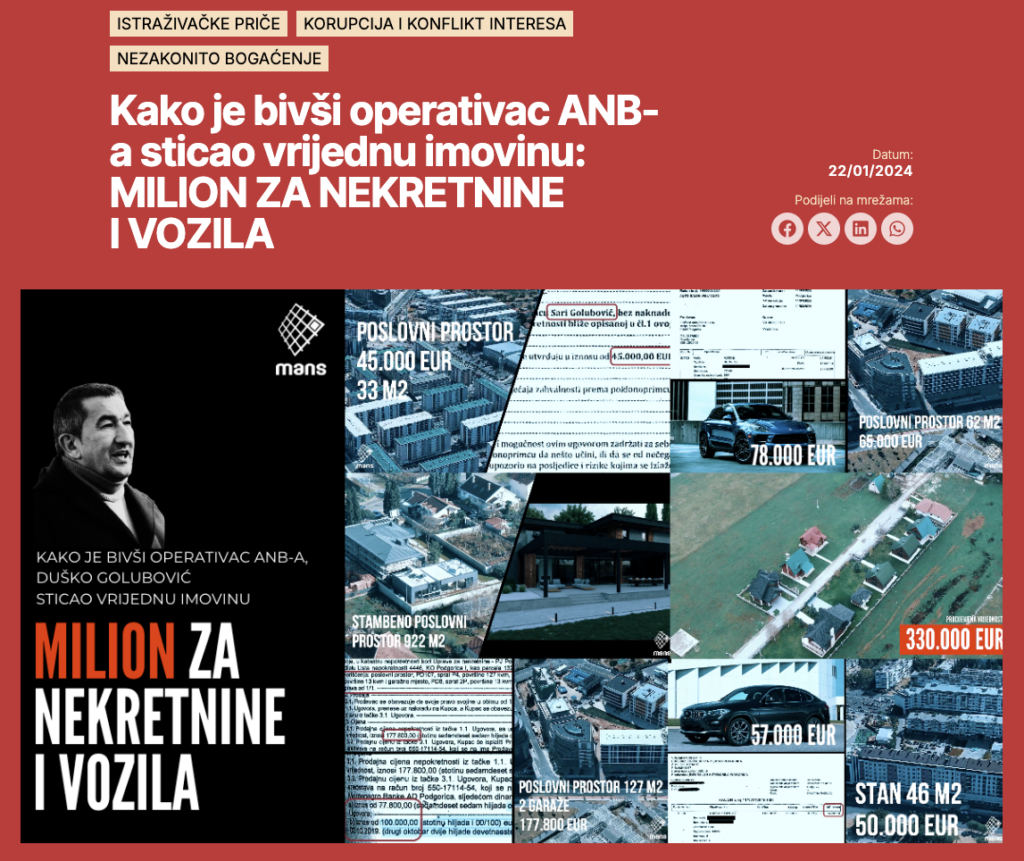
The research showed that family members gifted real estate to each other, while in some cases the money for the purchase of valuable property formally came from family members who had no known income to justify such transactions.
A particularly telling case is that of Duško Golubović, who reported receiving money from his son to purchase real estate, while other family members were simultaneously transferring valuable assets to each other through gifts and other legal arrangements. It is precisely these patterns of family transfers that represent one of the most common mechanisms for concealing the true origin of assets, which is why they are of crucial importance to the work of investigative journalists, the civil society, and institutions involved in the fight against corruption and organized crime.
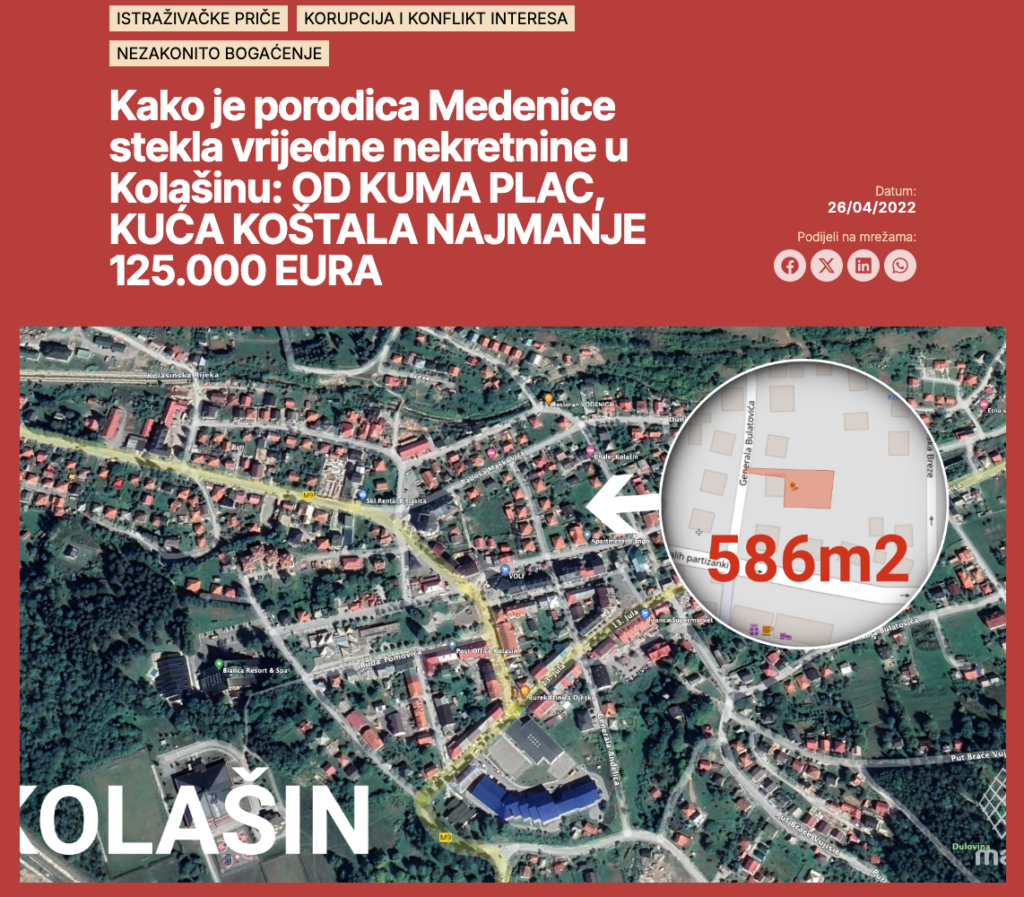
MANS documented a similar pattern in the case of the family of former Supreme Court President Vesna Medenica , who were convicted of unlawful influence, bribery and influencing court decisions, where the investigation showed that the Medenica family acquired valuable real estate in Kolašin from a godfather through legal arrangements that included a gift of land and the construction of a house valued at at least 125 thousand euros . It was precisely the analysis of such “godfather gifts”, transfers and subsequent transformations of property that raised serious questions about the real origin of the property and the possible concealment of benefits through formally permitted legal transactions.
MANS previously documented a case in which Vesna Medenica failed to declare her son’s income of around 215 thousand euros , with family financial connections and money transfers being a key element in understanding the overall financial situation and possible undeclared benefits within the family household. Such cases clearly show that potentially corrupt patterns are very often reflected not only through direct property purchases, but also through a network of family, godfather and related relationships through which property, money or other benefits are transferred.
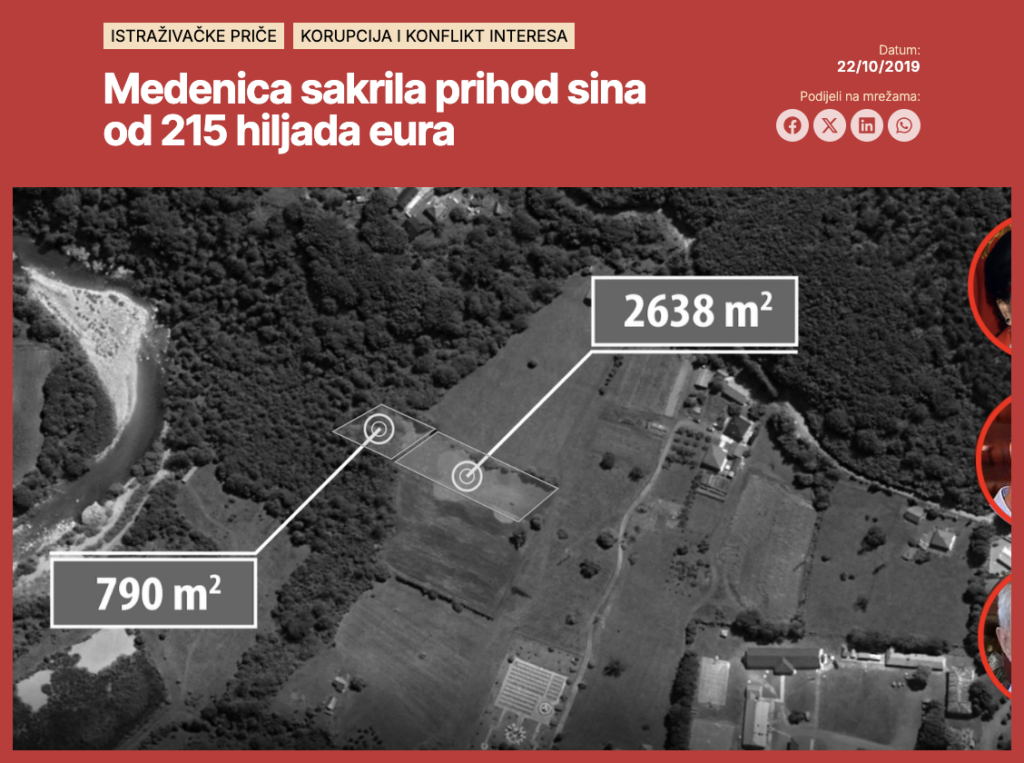
It is precisely the analysis of such property transformations that allows researchers, the media and the civil sector to identify potential patterns of concealment of real ownership, origin of assets, conflicts of interest and connections between public officials, their family members and business structures that have been the subject of public controversy for years.
If the logic contained in the relevant minutes of the Personal Data Protection Agency had been applied at that time, a significant part of that data could have been declared an inadmissible intrusion into the private and family sphere, even though it was information from public registers and a topic of undoubted public interest.
Free and open public debate on the origin of assets, suspicions of corruption and the consequences of corrupt behaviour is one of the key democratic achievements that Montenegro must continue to develop, especially in the final phase of European integration. Any legal interpretation that may have the effect of intimidating the media, researchers and the civil sector must be subject to serious professional and public debate.
MANS therefore believes that this type of action by the Personal Data Protection Agency must not become a practice, as it could significantly limit the public’s ability to control the property, interests and possible abuses of public officials and persons associated with them in the long term.
Dejan Milovac
Deputy Executive Director
of MANS